
[Article] Revealing the effective basal conditions of geophysical granular flows. Bougouin A., Dioguardi F., Capparelli G., Nicotra E., Sulpizio R. (2026). Journal of Geophysical Research Solid Earth 198:105648.
Citation:
Bougouin A., Dioguardi F., Capparelli G., Nicotra E., Sulpizio R. (2026). Revealing the effective basal conditions of geophysical granular flows. Journal of Geophysical Research Solid Earth 198:105648.
https://doi.org/10.1016/j.ijmultiphaseflow.2026.105648
Plain Summary
Geophysical gravity-driven flows — such as landslides, rock avalanches and pyroclastic flows — are common events on the Earth’s surface that shape landscapes and pose significant hazards to populations and infrastructure. However, accurately forecasting their behavior remains challenging, as they often travel faster and farther in natural settings than laboratory results would suggest. Consequently, the models used to simulate them are poorly reliable during real-world emergencies.
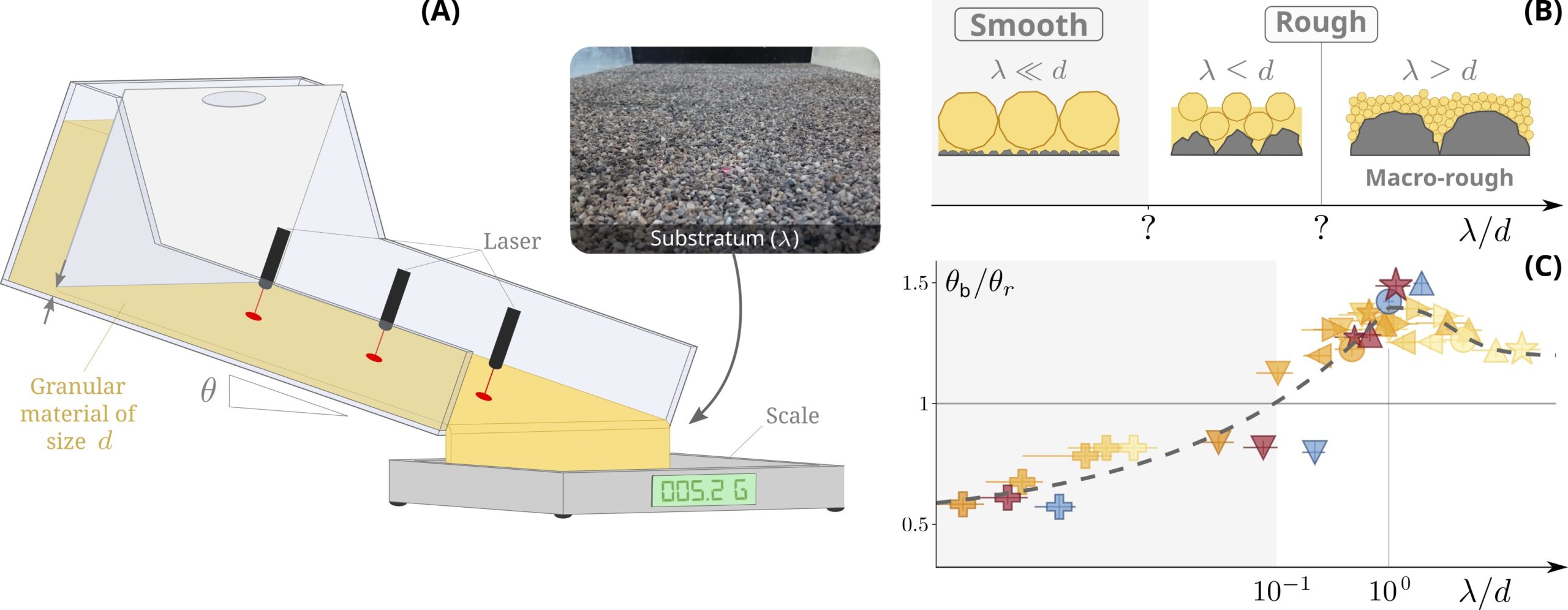
Many explanations have been proposed for why these flows travel so far, including their interaction withthe underlying surface. In this study, we tackle this question by investigating experimentally the influence of the basal condition on the propagation and deposition of steady granular avalanches by varying widely the flowing material – from idealized glass beads to sandy and volcanic materials – and the slope surface – from smooth Plexiglas to rough layers covered with glued millimeter-sized grains (Fig. A).
Our goal is to answer key questions: How does the ground surface affect flow speed and thickness? Can we define a simple criterion to describe the effective basal condition based on flow and substrate properties? Can we model avalanches on smooth and rough surfaces within a unified framework? And what is the minimal sethysical parameters needed to do so?ur experiments confirm that the ground surface has a critical role on granular avalanches. We show that the effective basal condition can be classified as smooth, rough, and macro-rough, based on the roughness-to-grain size ratio, which controls the basal friction angle (Figs. B and C). We present a unified framework describing the mass flow rate and flow thickness of granular avalanches across both smooth and rough basal-regimes. Specifically, avalanche behavior is primarily governed by the initial flow conditions and a small set of physical parameters characterizing both the flowing material and the underlying surface.
This study also opens new directions for future research. It provides a comprehensive experimental dataset — covering a wide range of inclinations, flow thicknesses, and diverse materials for both the flow and the substrate — that can be used to assess numerical models. It also raises important questions about how to define surface roughness and representative grain size in natural settings, where multiple scales coexist and change over space and time. Finally, it establishes a foundation for studying more complex and realistic avalanches in the laboratory, including thicker and unsteady flows that better reflect natural events.