
Joint workshop on “Experimental and numerical modelling approaches to investigate gravity flows”

PRIN PNRR 2022 – Improving the modeling capabilities of geophysical granular flows through experimental and numerical simulations
On 15-17 September 2025 we hosted the “Workshop on geophysical flows: from the laboratory to the nature” as part of the joint workshop “Workshop on experimental and numerical modelling approaches to investigate gravity flows”, which took place in Bari on 15-17 September 2025 and Rende (CS) on 17-19 September 2025. The workshop was organized in collaboration with another PNRR-funded project (RETURN). The event was also sponsored and supported by the Italian Association of Volcanology (AIV).
Click here to download the entire Report and the Programme (including Abstracts) of the event.
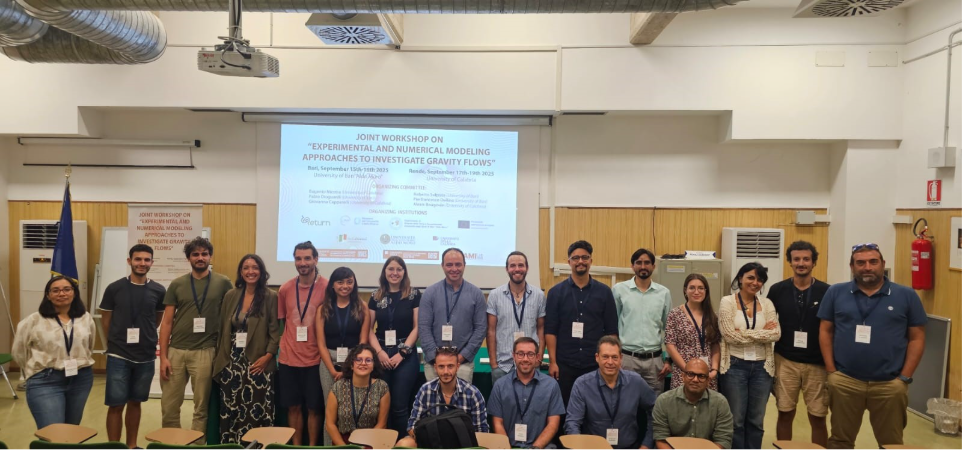
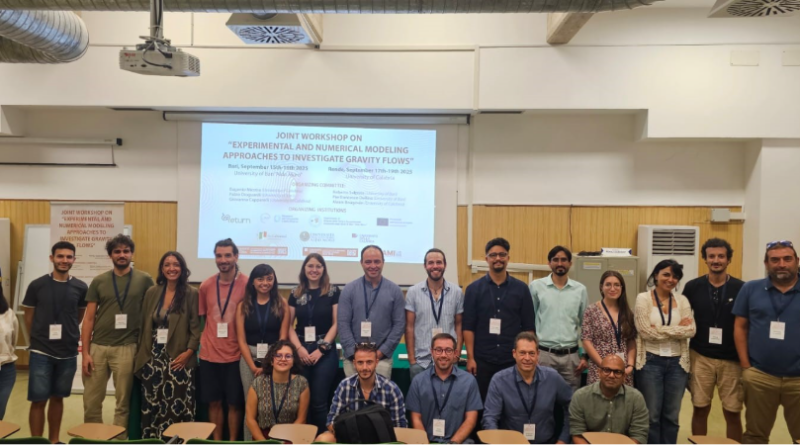
Figure 1. Picture of the participants taken at University of Bari “Aldo Moro”
The workshop saw the participation of 13 senior delegates, among whom 6 from foreign institutions, and 12 PhD students and early career researchers.
During the workshop, senior delegates gave lectures on the most important and emerging topics of gravity currents. PhD students and early career researchers also presented their work related to the general topic of the workshop and took an active role in fostering discussions during thematic round table discussions.
In the following we provide the detailed program. Readers are welcome to request copies of the presentation by emailing fabio.dioguardi@uniba.it.
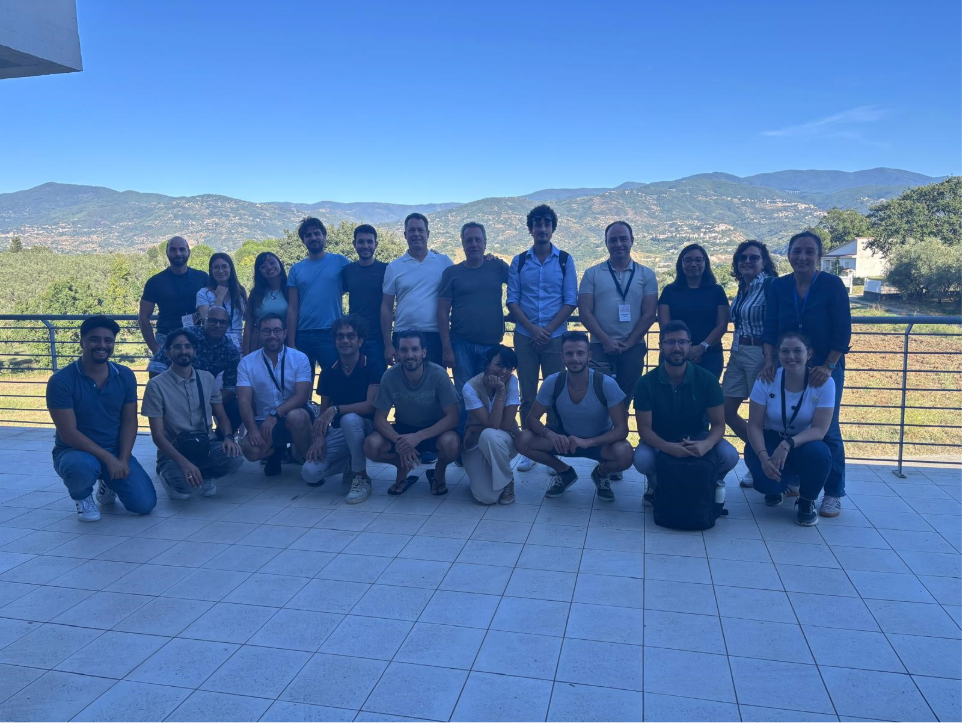
Figure 2. Picture of the participants taken at Polo “Sila”, University of Calabria
Programme
Workshop day 1 – 15/09/2025
- 08:30 – 09:00 Welcome
- Prof. Giuseppe Mastronuzzi, Director of the Department of Earth and Geoenvironmental Sciences, University of Bari “Aldo Moro”
- Prof. Roberto Sulpizio, Coordinator of the National Interest Doctoral School “Earth Processes and Management of Resources and Risks for a Resilient Society and Territory”
- Prof. Pierfrancesco Dellino, RETURN Foundation.
- 09:00 – 10:00 Roberto Sulpizio. From laboratory experiments to the field: the use of laboratory data for understanding the real flows
- 10:00 – 11:00 Francisco Rocha. The mechanics of granular avalanches
- 11:00 – 11:30 Break
- 11:00 – 12:00 Franco Tapia. Rheology of Dense Suspensions in Two-Phase Modeling for Bedload Transport
PhD-ECR day
- 12:00 – 12:20 Muhammad Ammar. Rheological Properties of Fluidized and Non-Fluidized Pyroclastic Material
- 12:20 – 12:40 Teresa Oreade Grillo. Rheological control on deposit-derived pyroclastic density currents (DD-PDC)
- 12:40 – 13:00 Carla Tranquilino Espinoza. Rheological Characterization of Volcanic Fine Sediment Suspensions: Intregrating Hyperconcentrated and Debris Flow Conditions
- 13:00 – 14:30 Break
- 14:30 – 14:50 Claudia Elijas-Parra. Pysammos: a new open-source Coarse-Graining tool to analysing the rheology of diverse volcanic granular flows
- 14:50 – 15:10 A. Frontoni. CARG-based (Sheet 416, 417, and 364) volume reassessment for the VEI 6/7 ignimbrites along the Roman Magmatic Province
- 15:10 – 15:30 Silvia Massaro. Modelling approaches for building probabilistic hazard maps of lahars inundation at Campi Flegrei caldera (Italy)
- 15:30 – 16:00 Break
- 16:00 – 16:20 Giorgio Costa. Investigating PDC-Forming Mechanisms at Basaltic Volcanoes through Large-Scale Granular Flow Experiments
- 16:20 – 16:40 Massimiliano Cardone. Multi-parametric study of the 2020-2022 paroxysmal activity at Mt. Etna: the role of fluids in the trigger mechanisms, durations and energy of the eruptive phenomena
- 16:40 – 17:00 Letizia Pace. The Role of Soil Moisture and Rheology in Sarno Volcaniclastic Debris Flows: Insights from Laboratory and Flume Experiments
17:00 – 17:20 Dario Milella. Numerical modelling of cliff stability problems in soft calcarenites: in-sights from MPM technique applications
Workshop day 2 – 16/09/2025
- 9:00 – 10:00 Thomas Jones. Particle modification in granular flows and the associated impact on flow properties
- 10:00 – 11:00 Alexis Bougouin. Laboratory modelling of gravity-driven flows: The emblematic dam-break configuration
- 11:00 – 11:30 Break
- 11:30 – 12:30 Damiano Sarocchi. Principles and Applications of Quantitative Textural Analysis
- 12:30 – 14:00 Break
- 14:00 – 15:00 Nikhil Nedumpallile Vasu. Multi-scale modelling of rainfall triggered debris flows. Case studies from diverse geoenvironmental settings
- 15:00 – 16:00 Lizeth Caballero Garcia. Calibration of lahar numerical models: The challenge of limited data
- 16:00 – 16:30 Break
- 16:30 – 18:30 Visit to the University of Bari experimental facilities
Workshop day 3 – 17/09/2025
- 08:00 Bus leave the Hotel, stops to the UniBa Campus to pick PhD students up
- 12:00 Arrival at Rende and Check-in at the Hotel
- 13:00 – 14:30 Light lunch at the University of Calabria (15/A cube)
- 14:30 – 15:00 Welcome and presentation of the CAMILab activities. Prof. Ing. Giovanna Capparelli, Director of CAMILab, University of Calabria (CAMILab Sezione SILA).
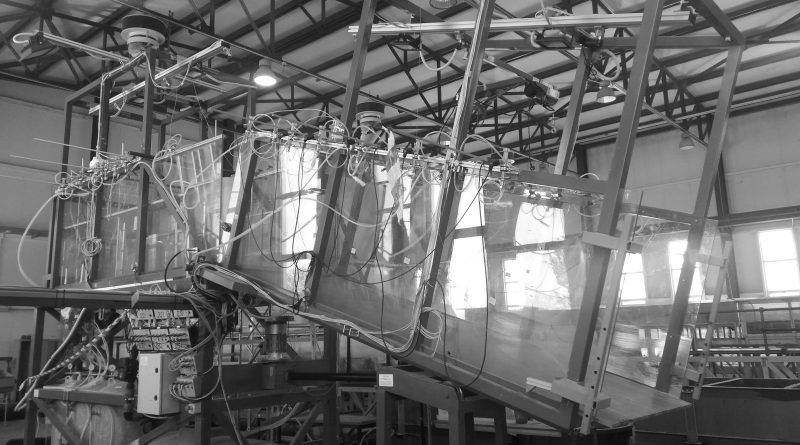
- 15:00 – 17:00 Presentation of the CAMILab laboratory (41/Z cube) and experimental setting. Demonstration experiment.
Workshop day 4 – 18/09/2025
- 08:30 – 09:00 Transfer by bus to CAMILab Lab (41/Z cube)
- 09:00 – 10:30 Discussion about the previous day’s experiment
- 10:30 – 11:00 Break
- 11:00 – 13:00 Workshop (CAMILab Sezione SILA): round table discussion on open topics
- 13:00 – 14:30 Break
- 14:30 – 16:30 Workshop (CAMILab Sezione SILA): round table discussion on open topics
- 16:30 – 17:30 Round tables’ leaders present outcomes of their discussion
- 17:30 End of works
Workshop day 5 – 19/09/2025
- 09:00 Transfer by bus to Bari
- 12:30 Arrival at Bari – End of the event
Funding acknowledgments
The workshop’s organization was supported by:
- the PRIN-PNRR 2022 project P2022CLRTF “Improving the modeling capabilities of geophysical granular flows through experimental and numerical simulations” funded within the European Union Next-GenerationEU (National Recovery and Resilience Plan – NRRP, Mission 4, Component 1, CUP H53D23011330001).
- the RETURN Extended Partnership, funded within the European Union Next-GenerationEU (National Recovery and Resilience Plan – NRRP, Mission 4, Component 2, Investment 1.3 – D.D. 1243 2/8/2022, PE0000005).